Uncooled IR detector vs cooled - which technology is right for your industrial application

Selecting an uncooled IR detector versus a cooled model is a fundamental first step. If cooling is necessary, choosing the right cooling technology becomes crucial.
While at first glance it may seem that a cooled IR sensor always has better performance, experience shows that sometimes less is more and an uncooled IR detector might be good enough. So why should I consider cooling an IR detector at all? Because it increases the performance of the device: lowers the noise level and increases the shunt resistance and responsivity. However, due to mechanical constraints this solution is not always applicable or, in other cases, it is simply not necessary.
What are the cooling types available for IR detectors?
There are several types of cooling available for infrared detectors such as:
- liquid nitrogen (LN2) dewars,
- cryocoolers,
- thermoelectric (TE) coolers,
- or no cooling.
Cryocoolers most used are either Stirling or -Thomson coolers while some niche applications use also even deeper cooling, e.g. liquid helium.
Liquid nitrogen (LN2)
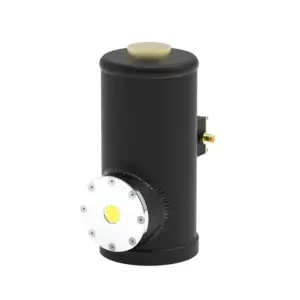 The first HgCdTe or InSb photon detectors required deep cooling to be usable at all – due to inherently high noise levels of those imperfect first devices. As the dominant noise mechanism in the semiconductor IR sensors is Johnson-Nyquist noise, proportional to ~4kT, lowering the temperature seemed only logical – and liquid nitrogen dewars were a relatively simple way to bring the temperature down to 77 K. Even after newer technologies of both cooling and detectors emerged, LN2 remains a valid method of cooling wherever ultimate performance and low noise is required. The main application of LN2-cooled detectors remains laboratory use, particularly in FTIR systems like spectrometers or microscopes. In other places, like any field applications, liquid nitrogen is not practical as it requires periodic refills.
TE coolers
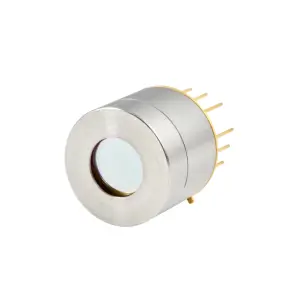 Researchers therefore were working tirelessly in the 1980s to figure out a way to manufacture IR detectors with lower noise, which could be operated in higher temperatures – without the need to refill the LN2. One of such research groups was one led by professor Józef Piotrowski in Poland, whose invention of High Operating Temperature (HOT) HgCdTe detectors led to creation of VIGO Photonics in 1987. These detectors could operate at temperatures achievable by miniature thermoelectric (TE) coolers – i.e. from 190 K up to 250 K – and later even room temperatures or above. These coolers rely on Peltier effect – when electrical current is run through the device, one end cools down while the other heats up. TE coolers can be composed of single or more stages, going up to 4-stage TEC to reach detector chip temperatures of 190-200 K. While obviously not matching the LN2-cooled devices for noise levels, TE-cooled IR sensors remain a favorite due to the best overall performance-cost ratio and possibility to operate in the field.
Uncooled MIR detectors
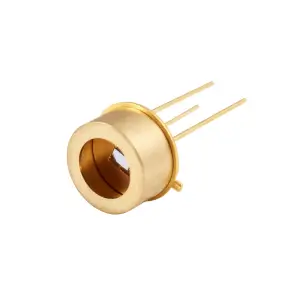 An advantage of HOT detectors is that they do not inherently require cooling to operate – relatively low noise makes them operable even in room temperature or slightly above, yielding useful signal. This is true for both HgCdTe and III-V-based detectors, like InAs or type II superlattice InAs/InAsSb devices. Getting rid of cooling has obvious advantages like saving significant amounts of space and electrical power (in case of TE coolers), as well as reducing cost. However, changing detector temperatures influences the parameters as described above. This needs to be considered when designing a system using uncooled MIR detectors. A reasonable compromise is using a simple single-stage TE cooler to stabilize the chip around room temperature – consuming less power than deeper cooling while guaranteeing stable parameters levels.
Cryocoolers
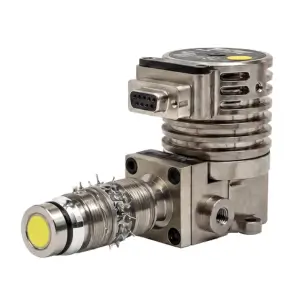
Some field applications allow no compromise in performance whatsoever – but cannot accommodate liquid nitrogen. For such cases, cryocoolers are the answer. The most common types of cryocoolers used for IR detectors are:
- Stirling coolers – mechanical coolers providing continuous cooling to temperatures between 77 K and 150 K, but requiring significant power budget
- Joule-Thomson coolers – single use coolers with very short startup time
In principle, single- or multi-pixel detectors can use these cryocoolers. An example is again FTIR spectroscopy – but this time for field use cases. This uses normally Stirling coolers. However, the most vivid example is Focal Plane Arrays (FPAs) for MWIR and LWIR. These devices for imaging or heatseeking require deep cooling to achieve desired parameters – and Stirling remains the most practical way to achieve extremely low temperatures for continuous, 24/7 use mandated by the users.
Can I cool down any infrared detector?
Operating temperature of the infrared detector needs to be accounted for during the design phase, as changes in temperature result in varying responsivity, detectivity and shunt resistance levels, as well as changes in spectral range of the device. Therefore, only detectors designed for cooling should be operated that way.
Summary
Because navigating the nuances of cooling options can be challening, we have summarized the key features, pros and cons of each type in the table below.
We hope this comparison helps you decide between cooled and uncooled IR detectors for your application. As always, our team is ready to assist you in selecting the solution that best suits your project.
Author: Jędrzej Mijas, Application Engineers Team Lead, VIGO Photonics
References:
Comparison of different types of cooling
| LN2 | Stirling | TEC | No cooling | |
| Features | • Operating temperature: 77 K • Dewars for holding liquid nitrogen • Traditionally only HgCdTe detectors |
• Operating temperature: 77 K to 150 K • Mechanical cooler • Used for single-pixel detectors or FPAs |
• Operating temperature: 190 K to 250 K • Principle of operation: Peltier effect • Single- or multistage TECs available • TO-format packaging |
• Operating temperature equal to ambient temperature • TO-format or SMD packaging |
| Advantages | • Best performance on the market thanks to extremely low temperature • Proven dewar design |
• 24/7 operation possible • No need to refill LN2 • Best performance on par with LN2 |
• Operation in all environmental conditions • Only DC required to power up • Short startup time • Small form factor • Significantly better performance than uncooled • Relatively low cost • Possible to use as a temperature stabilizer |
• Extremely easy to use • Excellent mechanical stability • No need for heatsinking • Low to no power consumption • Small form factor • Low cost |
| Disadvantages |
• Limited operation time w/o refilling • Need to refill LN2 • Not possible in field operations • Big form factor |
• High power consumption • Limited operation time due to mechanical wear • Very high cost |
• Power consumption not negligible • Heat sinking required • Reduced mechanical stability • Higher price than uncooled |
• Power consumption not negligible • Heat sinking required • Reduced mechanical stability • Higher price than uncooled |
Q&A Section
Question 1: Why are infrared (IR) detectors cooled, and how does cooling affect detector performance?
Answer: Infrared (IR) detectors are cooled to minimize semiconductor thermal noise -specifically Johnson-Nyquist noise - which directly increases the device's detectivity, as well as improves shunt resistance. Lowering the chip temperature lowers the noise floor to expose weak optical signals, though system designers must balance this sensitivity gain against added physical size, higher power consumption, and mechanical complexity.
Question 2: What are the main cooling technologies used for IR sensors, and what are their key applications?
Answer: The primary cooling solutions for IR detectors are thermoelectric (TE) coolers, liquid nitrogen (LN2) dewars, mechanical cryocoolers, and uncooled or TE-stabilized configurations. Multi-stage TE coolers provide an ideal cost-to-performance ratio for field-deployable HOT detectors, LN2 dewars offer ultra-low noise down to 77 K for laboratory FTIR spectroscopy, Stirling cryocoolers power continuous MWIR/LWIR focal plane arrays, and uncooled detectors eliminate power and space constraints for compact OEM devices.
Question 3: How do you choose between an uncooled, TE-cooled, and cryocooled IR detector for an industrial application?
Answer: Choosing between uncooled, TE-cooled, and cryocooled IR detectors requires trading off your application's required detection sensitivity against strict physical constraints like size, power budget, cost, and maintenance. Uncooled or single-stage TE-stabilized sensors suit space- and power-constrained industrial tools, multi-stage TE-cooled detectors fit maintenance-free field instruments, and deeply cooled Stirling or LN2 systems are reserved for non-negotiable high-sensitivity needs like 24/7 imaging and lab spectroscopy.