English
 Polski


Thermal Detection in Defense and Industry: A Guide to MWIR and LWIR Infrared Technology

Thermal detection is a critical technique based on the passive sensing of infrared (IR) radiation emitted by all objects with a temperature above absolute zero. This mechanism relies on thermal emission—objects radiate energy at wavelengths and intensities directly related to their temperature, a principle defined by Planck’s Law. In modern defense and industrial sectors, infrared technology serves as the "eyes" of the system, enabling precise operations across multiple domains.
Understanding Unique "Heat Signatures" and IR Target Tracking
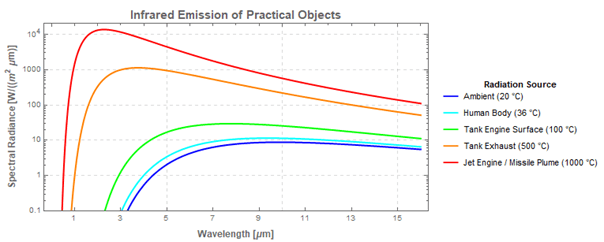
Every object, from an operating engine to a human body, possesses a unique thermal signature that distinguishes it from its surroundings. This enables precise target tracking and monitoring even in total darkness, smoke, or fog. Modern VIGO Photonics detectors go beyond static temperature points by analyzing targets across multiple dimensions:
- Spectral Distribution: According to Wien’s Displacement Law, the peak emission wavelength shifts as temperature changes. For instance, human emissions peak around 9.4 µm, while jet exhausts peak in the 3-5 µm range. By analyzing the signal ratio between bands, an IR seeker can distinguish a real engine from decoys like flares.
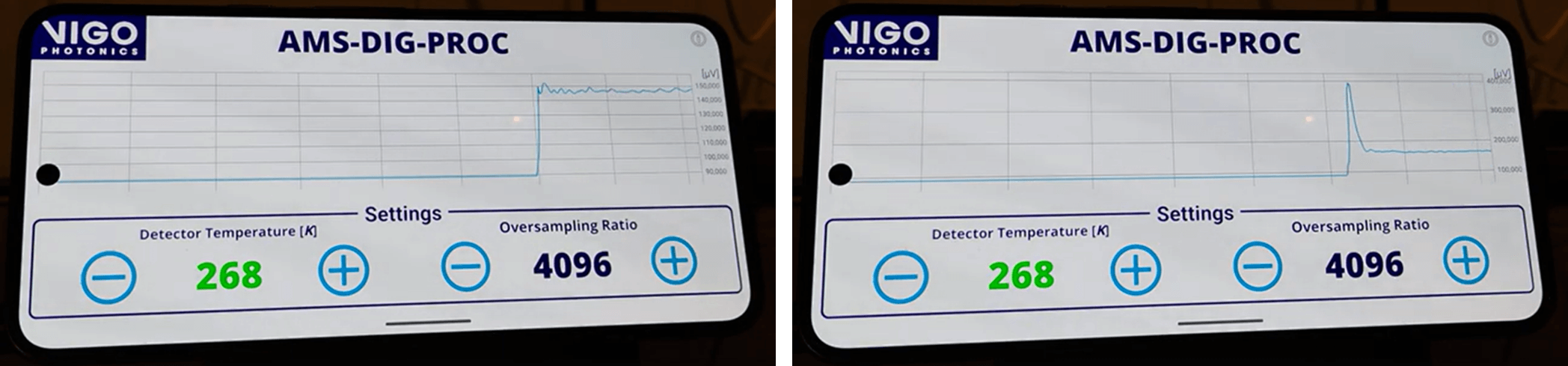
- Temporal Modulation: Many man-made IR sources exhibit specific modulation patterns, such as the "flicker" of rotating helicopter blades. High-speed VIGO detectors, featuring response times in the nanosecond range, can resolve these modulations to identify specific platforms or bypass active jamming.
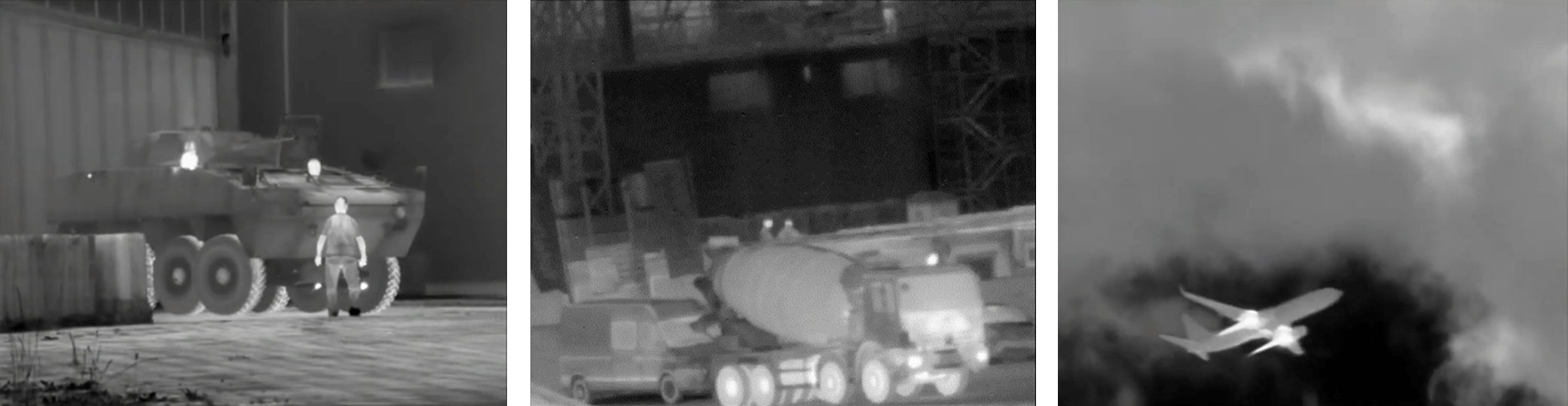
- Spatial Characteristics with IR Imaging: Systems utilizing multi-element and Focal Plane Array (FPA) detectors can recognize the shape and size of a heat source, preventing distraction by small, intensely hot point-sources.
Choosing the Right Infrared Band: MWIR vs. LWIR Detectors
The choice of detection band is strategic. Thermal sensing is typically performed in two specific atmospheric transmission windows where gases like water vapor and CO2 exhibit minimal absorption.
MWIR (3-5 µm - Mid-Wave Infrared) for High-Temperature Targets
The MWIR band is optimal for detecting high-temperature targets like missile plumes and aircraft engines.
- Performance: Objects at approximately 500C have their radiation peak within this window.
- Advantages: MWIR offers high thermal contrast and performs exceptionally well in high-humidity environments.
Pro Tip: Combining MWIR and LWIR enables Dual-Color Radiometry, allowing for precise absolute temperature measurements independent of the object's emissivity.
Applications and Portfolio: From Single-Element Detectors to FPA Matrices
VIGO Photonics provides a broad range of solutions tailored to specific industrial and defense scenarios:
Fire Detection and Contactless Temperature Measurement
Infrared monitoring enables instant fire detection by identifying sudden temperature spikes.
- Recommended Detectors: Uncooled PVIA-5 and PVI-5 series, as well as TE-cooled PVMA and PVI-2TE models.
IR Sensors for Smart Munitions and Precision Homing
Smart munitions rely on high-speed IR sensors for precision homing on moving vehicles.
- Key Products: PVMQ-10.6 (quadrant detector for seeker heads) and the 32MM-5 (32-element TE-cooled array).
IR Imaging and Wide-Area Surveillance
High-resolution identification over long distances is achieved through advanced imaging components.
- Key Product: Eagle MWIR FPA (640×512 format) for thermal imaging.
Infrared Solutions for Railway Transport Safety
IR sensors monitor train undercarriages to detect overheated bearings or brakes (Hot Axle Box Detection).
- Key Products: 4EM-5 and 32EM-5 linear detector arrays, optimized for scanning fast-moving objects.
Author: Piotr Paszke, Application Engineer
Contact our Technical Support team for specific information on our capabilities.